Digital marketing has changed significantly over the last few years. Tasks that once required hours of manual research, analysis, and optimization can now be completed much faster with the help of artificial intelligence.
From understanding customer behavior to improving advertising campaigns and creating content, AI is becoming an important part of modern marketing. But using AI successfully isn’t simply about automating everything. Businesses still need people who understand their audience, brand, goals, and market.
The real opportunity comes from combining AI-powered digital marketing services with human experience and strategic thinking.
In this article, we’ll look at how AI is changing digital marketing, the services businesses are using today, and how you can decide which AI-driven strategies make sense for your business.
How AI Has Changed Digital Marketing
Traditional digital marketing often involved collecting data, reviewing reports, and manually deciding what needed to change. While that approach still has value, AI can process large amounts of information much faster and identify patterns that may be difficult to spot manually.
For example, AI can help marketers understand which keywords people are searching for, which advertisements are performing better, what type of content attracts engagement, and which customers are more likely to convert.
This doesn’t mean that marketers are no longer needed. Instead, their role is changing.
AI can help with data analysis and repetitive tasks, while marketers can spend more time on strategy, creativity, messaging, and understanding the customer.
Trending AI-Powered Digital Marketing Services
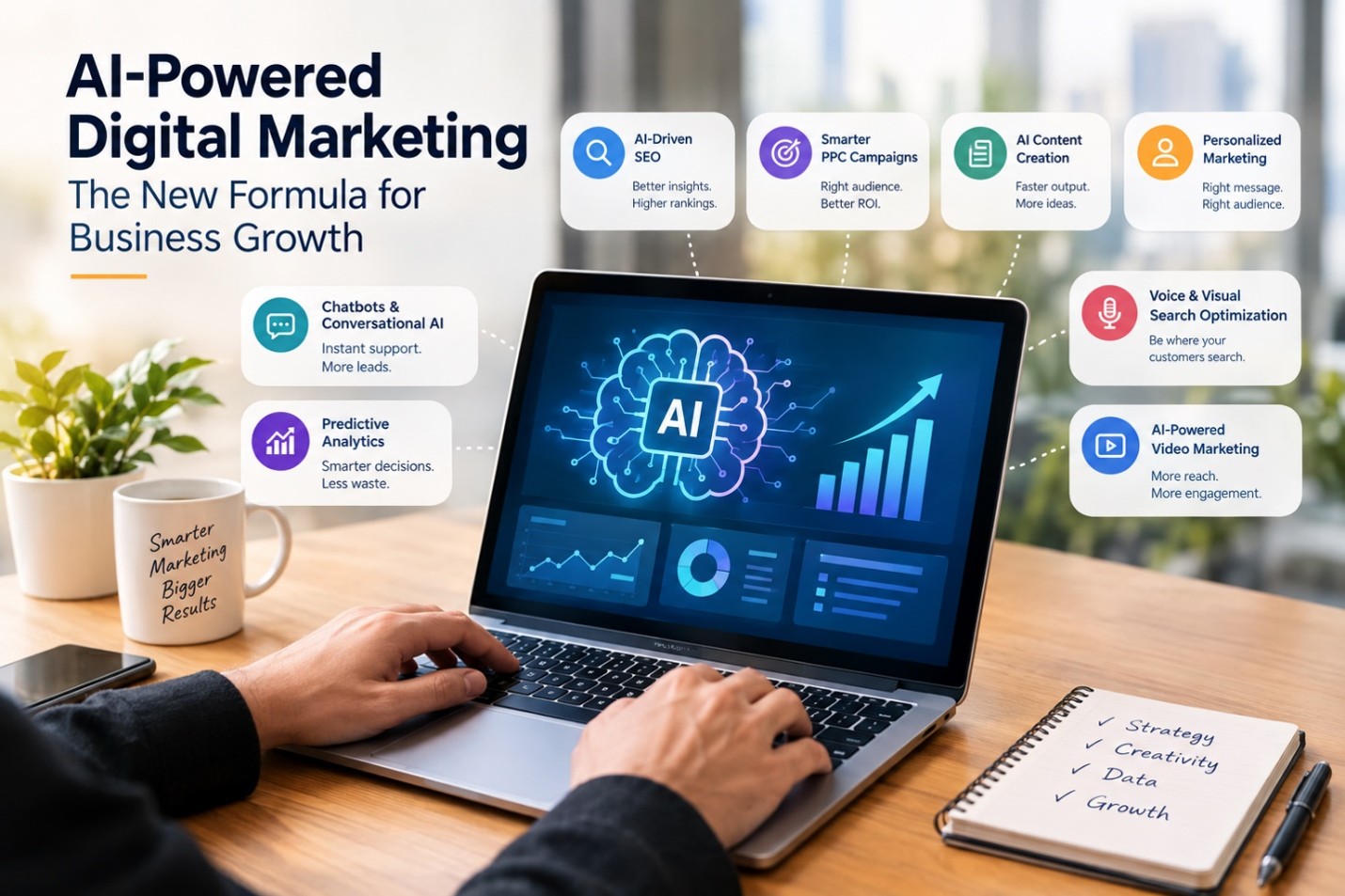
- AI-Driven SEO
SEO has moved well beyond simply adding keywords to a webpage.
AI-powered SEO tools can help marketers analyze search intent, identify content opportunities, study competitors, discover related topics, and find gaps in existing content.
AI can also help businesses understand how search is changing as search engines increasingly provide more direct answers to users.
However, good SEO still depends on useful information, accurate content, a strong website experience, and a clear understanding of what the audience actually needs. AI can make the process faster, but it doesn’t replace thoughtful SEO strategy.
- AI-Optimized PPC and Paid Advertising
Paid advertising platforms such as Google Ads and Meta Ads increasingly use automation and machine learning to help advertisers manage bidding, audience targeting, placements, and campaign optimization.
This has changed the way marketers manage PPC campaigns. Instead of manually controlling every small setting, marketers can focus more on campaign goals, creative testing, audience signals, conversion tracking, and overall strategy.
AI can help identify patterns and optimize campaigns, but accurate tracking and good-quality advertising data remain essential.
- AI-Assisted Content Creation
AI has made content creation considerably faster.
Businesses can use AI to generate initial ideas for blog posts, social media captions, email campaigns, product descriptions, video scripts, and advertising copy.
But there’s an important difference between AI-generated content and good content.
A useful piece of content should sound like the business behind it. It should provide accurate information, reflect the brand’s personality, and address the reader’s actual questions.
That’s why many successful marketing teams use AI as a writing assistant rather than allowing it to produce and publish everything without review. Human editing and fact-checking help turn a basic AI draft into content that feels authentic and useful.
- Personalized Marketing
Customers don’t always respond to generic messages.
AI can analyze customer interactions and behavior to help businesses create more relevant marketing experiences. This can include personalized email campaigns, product recommendations, website content, and advertising messages.
For example, an e-commerce business can recommend products based on previous browsing or purchasing behavior.
When personalization is relevant and used responsibly, it can make the customer experience more useful instead of making marketing feel repetitive or intrusive.
- Chatbots and Conversational AI
Customers often want answers immediately. Waiting several hours or even a full day for a response can mean losing a potential customer.
AI-powered chatbots can answer common questions, collect basic information, schedule appointments, recommend products, and help qualify leads at any time of the day.
For businesses that receive inquiries outside normal working hours, this can be particularly useful.
However, complex or sensitive questions may still require a human representative. The goal should be to make customer communication easier, not remove the human element completely.
- Predictive Analytics
One of the most useful applications of AI is its ability to analyze historical data and identify potential patterns.
Businesses can use predictive analytics to understand which customers may be more likely to purchase, which leads may require additional attention, or where customer churn could become a concern.
These insights can help businesses make better decisions about where to spend their marketing budget.
Of course, predictions are not guarantees. The quality of the result depends heavily on the quality and relevance of the underlying data.
- Voice and Visual Search Optimization
People are increasingly using different ways to search for information. Instead of typing a short keyword into a search engine, users may ask questions through voice or search using images.
This creates new opportunities for businesses to make their content easier for search systems to understand.
Clear answers, descriptive information, structured content, relevant images, and accurate business information can all contribute to a stronger overall search presence.
- AI-Powered Video Marketing
Video has become an important part of digital marketing, but producing videos consistently can take significant time.
AI tools can assist with tasks such as transcription, subtitles, translation, editing, script development, and content repurposing.
For example, a long-form video can be transformed into several shorter pieces of content for different social media platforms.
This allows marketing teams to get more value from content they’ve already created while reducing some of the repetitive work involved in production.
Why AI-Driven Digital Marketing Matters Today
- Faster Marketing Workflows
AI can reduce the time required for repetitive tasks such as research, reporting, content ideas, audience analysis, and campaign variations.
This gives marketing teams more time to concentrate on planning and creative work.
- More Efficient Use of Data
Modern businesses generate a large amount of customer and marketing data. Reviewing all of it manually can be difficult.
AI can process this information quickly and help identify trends that marketers can investigate further.
- Better Opportunities for Personalization
Instead of delivering exactly the same message to every customer, businesses can use data and AI to make marketing more relevant to different audiences.
- Faster Campaign Optimization
AI-powered advertising platforms can identify performance patterns and make adjustments much faster than traditional manual processes.
That doesn’t guarantee better results, but it can help marketers respond to campaign data more efficiently.
- Ability to Scale
As a business grows, its marketing requirements usually grow as well.
AI can help businesses manage larger amounts of content, data, customer interactions, and campaign variations without increasing every manual task at the same rate.
How to Choose the Right AI Marketing Strategy for Your Business
There is no single AI marketing strategy that works for every business.
The right approach depends on your industry, customers, budget, goals, and existing marketing channels.
For New Businesses
New businesses may benefit from focusing on foundational activities such as local SEO, website content, social media, and customer communication.
AI can help speed up research and content production while keeping the business focused on building a strong online presence.
For E-Commerce Businesses
E-commerce brands can explore AI-powered product recommendations, personalized email campaigns, advertising optimization, customer segmentation, and content creation.
The goal should be to use AI where it improves the shopping experience or helps the business understand customers better.
For B2B Companies
B2B businesses can use AI for lead research, lead scoring, content development, email personalization, and marketing analysis.
Because B2B sales cycles can be longer, AI can be particularly useful for organizing customer information and identifying potential opportunities.
For Local Service Businesses
Local businesses can benefit from AI-powered chatbots, automated customer responses, local SEO support, appointment management, and review monitoring.
Quick communication can be especially valuable when potential customers are comparing several local providers.
AI and Human Expertise: Why Both Matter
It’s easy to think that AI can handle the entire marketing process. In reality, the strongest approach is usually a combination of technology and human expertise.
AI is excellent at processing information, recognizing patterns, automating repetitive tasks, and generating ideas.
People are still responsible for understanding the brand, communicating with customers, making strategic decisions, checking accuracy, and deciding what the business should actually say.
A marketing campaign can be technically optimized and still fail if the message doesn’t connect with the intended audience.
That’s why AI should be viewed as a powerful marketing tool rather than a complete replacement for marketers.
Final Thoughts
AI is becoming an important part of digital marketing, and businesses have many opportunities to use it more effectively.
From SEO and paid advertising to content creation, personalization, chatbots, analytics, and video marketing, AI can help businesses save time and work with data more efficiently.
But technology alone doesn’t create successful marketing.
Businesses still need a clear strategy, useful content, authentic communication, reliable data, and a strong understanding of their customers.
The most practical approach is to use AI for what it does well while keeping human judgment at the center of important decisions. When technology and human expertise work together, businesses can create marketing that is not only faster, but also more relevant and meaningful.
Frequently Asked Questions (FAQ)
Q1. Will AI replace digital marketing agencies?
AI is changing the way digital marketing agencies work, but it doesn’t eliminate the need for human expertise. Strategy, creative direction, brand positioning, communication, and decision-making still require human involvement.
Q2. How much do AI-powered digital marketing services cost?
The cost depends on the services required, business size, industry, advertising budget, and level of support. A small business may start with a limited set of AI-assisted tools, while larger companies may invest in several platforms and ongoing marketing services.
Q3. Can AI-generated content rank on Google?
AI-assisted content can perform in search when it provides useful, original, accurate, and relevant information. The important factor is the quality and value of the content rather than simply whether AI was involved in creating it.
Businesses should avoid producing large amounts of low-value content simply for the purpose of attracting search traffic.
Q4. Which businesses can benefit from AI marketing?
Almost any business can find useful applications for AI. E-commerce companies, local businesses, professional services, B2B companies, and businesses that generate a high volume of leads can use AI for tasks such as customer analysis, content creation, advertising, and communication.
Q5. Can small businesses afford AI marketing tools?
Yes. There are many AI-powered tools available at different price points, including tools with free or entry-level plans.
Small businesses don’t necessarily need a large technology budget. Starting with one or two areas where AI can solve a real business problem is often more practical than adopting numerous tools at once.
Q6. How long does it take to see results from AI marketing?
The timeframe depends on the marketing channel.
Paid advertising and automated customer communication can produce measurable activity relatively quickly, while SEO and content marketing generally require more time to build visibility and authority.
Results also depend on factors such as competition, budget, website quality, audience, and the quality of the strategy.
Q7. What is Generative Engine Optimization (GEO)?
Generative Engine Optimization, commonly referred to as GEO, is an emerging approach that focuses on making information easier for AI-powered search and answer systems to understand, retrieve, and reference.
As search behavior continues to evolve, businesses are exploring ways to make their content useful not only for traditional search engines but also for newer AI-driven search experiences.
Q8. Is human involvement still necessary in AI marketing?
Yes. AI can assist with research, analysis, automation, and content creation, but people are still needed for strategy, quality control, brand communication, ethical decisions, and understanding customer needs.
Q9. How often should a digital marketing strategy be reviewed?
Marketing performance should be monitored regularly, but the frequency of major strategy changes depends on the business and marketing channel.
Monthly performance reviews can help identify problems and opportunities, while larger strategic reviews can be conducted periodically based on campaign performance and business goals.
Q10. Are AI marketing tools safe for customer data?
Businesses should carefully evaluate any AI tool before using it with customer information.
Privacy policies, security practices, data retention, access controls, and applicable data protection requirements should all be reviewed. Sensitive customer information should not be shared with a tool unless the business has confirmed that its use is appropriate and compliant with relevant requirements.
The Future of Digital Marketing
AI is not simply another marketing trend. It is becoming part of the technology behind many everyday marketing activities.
The businesses that benefit from it will not necessarily be the ones using the most AI tools. They will be the ones using the right tools for the right problems while maintaining the human understanding that makes marketing meaningful.
The future of digital marketing is not simply about AI replacing people. It’s about using technology to help people work smarter, understand customers better, and create more relevant experiences.